
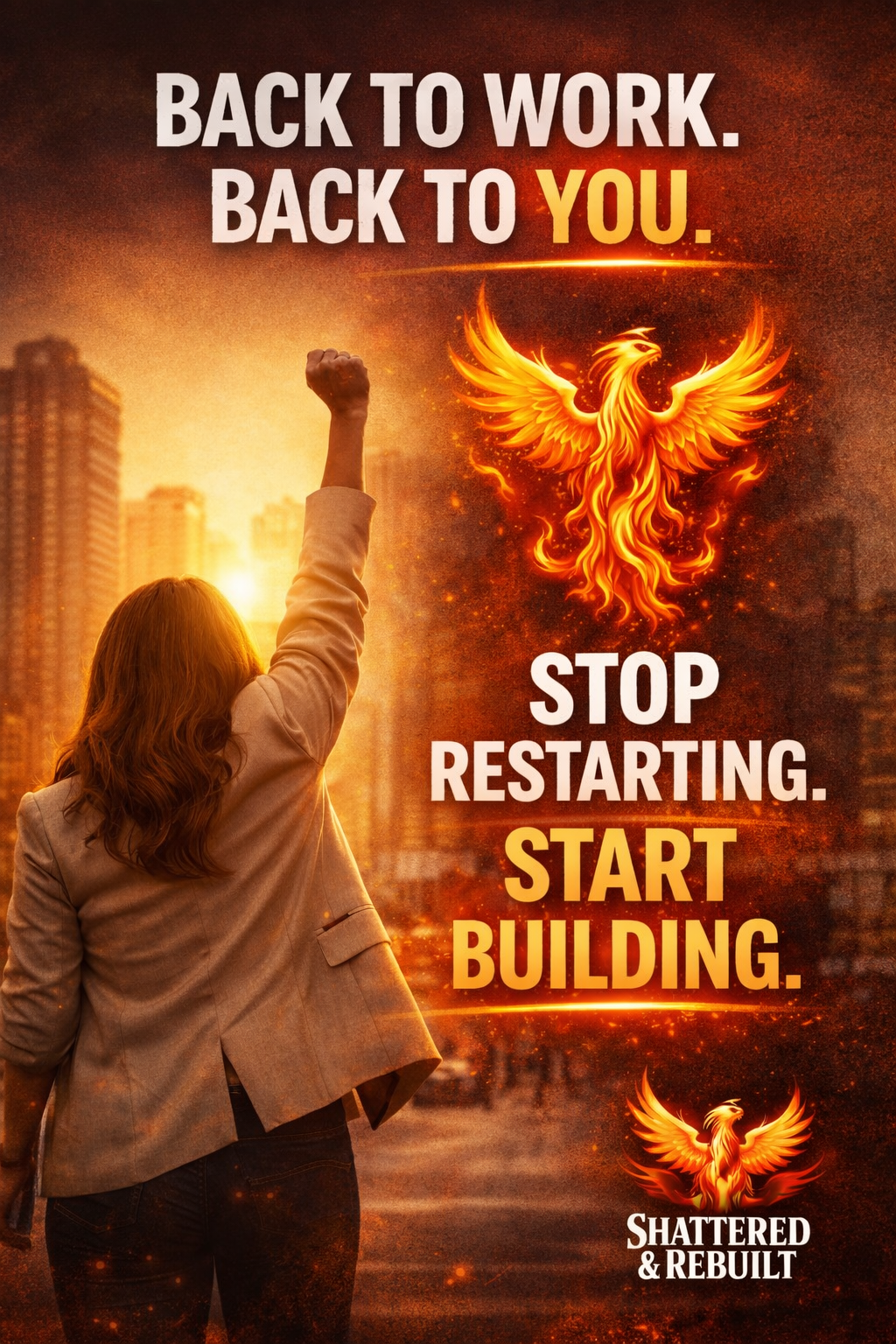
Back To Work. Back To You.
There comes a moment where you get tired of your own cycle. Not just tired for a day, not just frustrated in the moment, but genuinely exhausted with repeating the same pattern. You tell yourself you’re going to change. You get motivated. You start strong. And then somewhere along the way, you fall off. Not because you don’t care, but because life gets real again.
Work picks up. Your energy drops. Your focus slips. And before you even realize it, you’re right back where you started. Again.
That’s the part most people avoid talking about. Not the motivation, not the planning, not the “new beginning” energy—but the fall-off. The quiet return to old habits. The slow drift back into the same place you were trying to escape.
And after a while, it starts to mess with your confidence. You stop trusting yourself. You start questioning whether you’re actually capable of staying consistent. You tell yourself this time will be different, but deep down, you’ve said that before.
That’s where the shift has to happen.
Because the truth is, you don’t need another fresh start. You need to stop restarting.
Restarting feels productive, but it’s not. It gives you the illusion of progress without actually building anything. Every time you restart, you erase your momentum. You go back to zero. And starting from zero over and over again is what drains you, not the work itself.
The real problem isn’t that you don’t know what to do. It’s that you don’t have anything in place to hold you up when you don’t feel like doing it.
That’s why the first step is getting organized.
Not in a perfect, color-coded, everything-is-flawless type of way. But in a real, practical way. You need structure. You need to know what your day looks like before it starts. You need to know what matters and what doesn’t. Because when everything feels important, nothing gets done properly.
Organization isn’t about being neat. It’s about control.
Control over your time. Control over your energy. Control over where your attention goes.
Without that, you’re reacting to life instead of running it.
And when you’re constantly reacting, you burn out faster. You get overwhelmed quicker. You lose focus easier. That’s when consistency breaks.
Then comes the next layer—your body.
You can’t rebuild your life while running on empty. If you’re tired all the time, if you’re constantly stressed, if your energy is low, you’re fighting an uphill battle every single day. You’re trying to stay disciplined with no fuel.
Taking care of your body isn’t extra. It’s necessary.
It’s what gives you the energy to follow through. It’s what keeps your mind clear. It’s what helps you stay grounded when everything around you feels chaotic.
You don’t have to be perfect. You don’t need a strict routine overnight. But you do need to start paying attention to how you treat yourself physically. Because your energy will always determine your consistency.
And that leads to the part that ties everything together—getting grounded.
Getting grounded means you stop running from yourself. You stop avoiding the truth about where you are and what needs to change. You stop making excuses that you’ve already heard before.
It’s where self-love becomes action.
Not just feeling better about yourself, but doing better for yourself. Keeping promises to yourself. Showing up when you don’t feel like it. Choosing discipline over comfort.
Because real self-love doesn’t always feel soft. Sometimes it feels like accountability.
And this is where most people either level up or fall back.
Because life is not going to slow down for you.
Your responsibilities aren’t going anywhere. Your job isn’t getting easier overnight. Stress doesn’t just disappear because you decided to change.
So if your plan only works when things are calm, it’s not a real plan.
You have to build through life, not around it.
That means showing up when you’re tired. That means doing the work when you don’t feel like it. That means staying consistent even when your motivation is gone.
Because motivation will leave. It always does.
What stays is discipline.
What stays is structure.
What stays is the decision you made when you were serious about changing.
And if you don’t build that now, you already know what happens next.
You restart.
You tell yourself “this time is different.”
And then a week later, you’re back in the same position.
That’s the cycle you have to break.
Not by doing everything at once, but by doing something consistently.
One step. One action. One decision at a time.
Because real progress isn’t fast. It’s steady.
It’s built in the days you don’t feel like it.
It’s built when nobody is watching.
It’s built when you could quit, but you choose not to.
So this time, it’s not about starting over.
It’s about continuing.
It’s about staying in it long enough to actually see change.
Because if you don’t change now, you won’t change later.
You’ll just restart again.
And again.
And again.
Until you finally decide you’re done with that version of yourself.
Back to work doesn’t just mean going to your job.
It means getting back to the work of building you.
Back to you means taking control of your life again.
Your time.
Your energy.
Your direction.
So this time, it’s not “someday.”
It’s now.